
The Price of a Name
Identity, anonymity and value in art markets — a survey of the evidence
A name is not a neutral label attached to a work; it is a financial instrument. This survey assembles what is actually known — and distinguishes it from what is merely repeated — about how artist identity enters price. We cover four bodies of evidence: the structure of art markets under radical uncertainty, where no inspectable property of an object reliably predicts what it sells for; the machinery by which a small number of names come to hold most of the market’s value; the measured price gap between men and women artists, whose magnitude turns out to depend almost entirely on how it is measured; and the natural experiments in which identity is removed from a judgement and the outcome observed. We find the case for anonymity real but narrower and more contested than its popular version, and we report the evidence against it — pseudonymity has a measured price, and an anonymous market has costs of its own. The survey concludes with what an anonymous gallery can and cannot claim.
Method note: every figure below was traced to a primary source. Claims that could not be verified against the document said to contain them were removed rather than hedged, including several that circulate widely. Where the literature disagrees, the disagreement is in the body text, not a footnote.
1The market that cannot price its goods
Almost everything a buyer would want to know about an artwork is unobservable at the moment of purchase.
Art is a durable, unique, non-productive asset whose quality cannot be established by inspection and whose resale value is unknown. Beckert and Rössel call the resulting condition fundamental uncertainty, and argue that what resolves it is not any property of the object but reputation — an intersubjective assessment produced by experts in the field.[9] Becker had already made the sociological version of the argument: a work is the output of a whole cooperative network, not a single hand.[10] Bourdieu supplies the economics of belief that sits underneath both.[15]
The financial literature bears the difficulty out. Mei and Moses built a repeat-sales index from 4,896 price pairs — 899 American, 1,709 Impressionist, 2,288 Old Master — traced through Sotheby’s and Christie’s New York catalogues, with a mean holding period of 28 years. Art returned 8.2% real per annum over 1950–1999 against 8.9% for the S&P 500, at a standard deviation of 21.3%.[28] The authors are careful in a way their citers are not: the mean, they write, “should be regarded as approximate, or as an upper bound on the average return obtained by investors over the period”, and could be reduced further by transaction costs.
The upper bound turned out to matter. Korteweg, Kräussl and Verwijmeren showed that whether a painting comes to auction at all depends on how it has performed — an asymmetric, V-shaped relation between sale probability and return. Correcting for that selection cuts index returns from 8.7% to 6.3% and the Sharpe ratio from 0.27 to 0.11.[27] Renneboog and Spaenjers, working hedonically across more than a million transactions, put real appreciation at 3.97% per year for 1957–2007 — “a performance similar to that of corporate bonds — at much higher risk”.[34]
Even the field’s most-cited stylised fact is unsettled. Mei and Moses reported a masterpiece effect — a 10% higher purchase price predicting 0.1% lower annual returns — and noted in the same paper that Goetzmann had found no such effect. Ashenfelter and Graddy found masterpieces underperforming by about 5% a year in Contemporary art and no effect at all in Impressionist art, while the abstract of the same paper states the conclusion without the exception.[4] Korteweg and colleagues report that redefining “masterpiece” by art-historical prominence rather than by price reverses the sign entirely.[27]
When quality cannot be observed, price stops being a measurement of value and starts being a substitute for it. What the market then has to price is not the object but the confidence attached to it — and confidence attaches to names.
Two further mechanisms make the object still less decisive. Beggs and Graddy show that both hammer prices and expert pre-sale estimates anchor on a work’s own previous auction price, identified by holding unobservable quality constant across the two sales of the same painting.[11] And a work that fails to sell is “burned”: in Ashenfelter and Graddy’s data the second sale of a previously unsold work averages 1.75× its first estimate against 3.77× for works that sold both times (t = 3.01).[4] The painting has not changed. Its record has.
2How “blue chip” is manufactured
Concentration in this market is not a tendency. It is the market’s basic shape.
In 2025, works selling above $1 million made up less than 1% of auction transactions and 54% of auction value, while a stable 95% of lots sold below $50,000 and accounted for 15% of value.[3] Dealers report a third of their sales coming from their single best-selling artist and 53% from their top three. The same report puts the global market at $59.6 billion in 2025.
Twenty names, a third of the sector
Postwar & Contemporary auction value in 2025, by artist rank. The top five artists took 16% of the sector's value and the top twenty took 36% — from a population of tens of thousands of artists with auction records. Modern is more concentrated still (top five 32%, top twenty 57%); Old Masters least (top five 12%, top twenty 28%). Concentration is not evenly distributed across sectors, and it is highest where the market is most confident about names.
Source: Art Basel & UBS, The Art Market 2026, Section 3.
Table view
| Rank band | Share of Postwar & Contemporary auction value |
|---|---|
| Top 5 artists | 16% |
| Artists 6–20 | 20% |
| Everyone else | 64% |
Two theories compete to explain this, and the difference between them matters for anyone who believes a market rewards merit. Rosen’s superstar model requires imperfect substitution — lesser talent is a poor substitute for greater — so small talent differences produce enormous income differences.[36] Adler’s model requires no talent differences at all: because appreciating art takes accumulated knowledge, and it is cheaper to acquire that knowledge about an artist others already discuss, stars can emerge among people of exactly equal ability.[2] Adler’s is the uncomfortable one, and it is the one the art data tends to support.
Fraiberger and colleagues traced 497,796 gallery exhibitions and 127,208 auction sales and found that an artist’s position in the exhibition network — not any property of the work — predicts price and career trajectory, and that this position locks in early.[22] Bikhchandani, Hirshleifer and Welch give the general mechanism: an informational cascade, where it becomes rational to ignore your own information and follow the crowd.[12]
The machinery is also literal. In the first half of 2025, 73% of postwar and contemporary evening-sale value at Christie’s, Sotheby’s and Phillips was covered by guarantees or irrevocable bids — a record — with third-party guarantors typically taking 15–20% of the upside.[29] The prices that anchor the market are, to that extent, underwritten before the room opens. And from March 1995 the two houses ran an outright seller’s-commission cartel; Christie’s and Sotheby’s settled civil claims at $256 million each.[4]
It is worth noting where the folklore fails. The market’s belief that death raises prices does not survive contact with data: Ursprung and Wiermann find an inverted-U in age at death, with death reducing prices for artists who die young[44], and De Silva and colleagues find prices declining 7% after death across London auctions from 1741 to 1913.[20] A story everyone in the trade knows, and the evidence points the other way.
3The name as instrument
Barthes and Foucault described the author as a device for closing meaning. The art market uses it to close a valuation.
To give an author to a text, Barthes wrote, “is to impose upon that text a stop clause, to furnish it with a final signification, to close the writing”; he treats the author as a historical and economic figure rather than a natural one.[5] Foucault is more precise about the mechanism. An author’s name “is not simply an element of speech… Its presence is functional in that it serves as a means of classification. A name can group together a number of texts and thus differentiate them from others.”[21] That is a description of the author-function, and it is also, exactly, a description of an attribution.
The attribution is where the money is. Knoedler — founded 1846, closed in November 2011 after 165 years — paid Glafira Rosales $950,000 for a purported Rothko and sold it for roughly $8.4 million, a markup of some 773%. Around forty forged Abstract Expressionist works passed through the gallery. The painter who made them, Pei-Shen Qian, was paid between a few hundred dollars and about $9,000 a canvas. Every hand that touched those objects was the same before and after discovery; only the name changed, and with it the price, from millions to nothing.
Newman and Bloom identify two mechanisms behind this in five experiments: contagion — the belief that an original carries physical traces of its maker — and judgements of unique creative performance.[31] Neither is a property of the object.
The most direct evidence comes from art that has no name at all. Radermecker, studying the market for anonymous paintings, finds that price is driven by the specificity of the substitute designation — how precisely the market can say which anonymous hand this was.[33] Works assigned provisional names — the “Master of…” convention of art history — have themselves become autonomous brand names, and outperformed works by named artists over 1955–2015. A name need not belong to a person to do a name’s work. It only needs to be a stable handle for a body of work.
This is the finding an anonymous gallery must sit with honestly: the market does not require a person. It requires something to accumulate around. Remove the biography and an address will do.
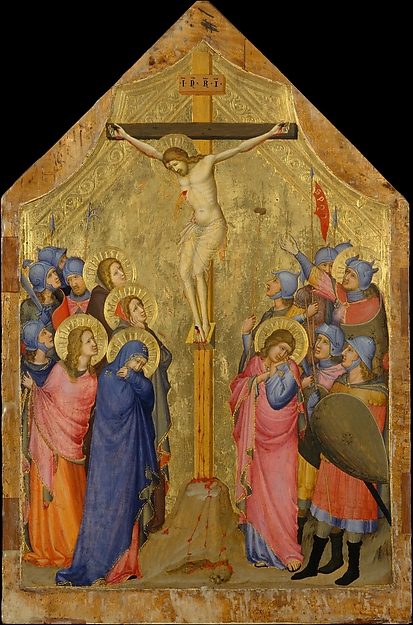
Nobody knows who painted this. The name on the label — Master of the Codex of Saint George — was invented by art historians to group a body of work whose maker is unrecoverable, and it is derived from another object, a manuscript. It is a pure author-function in Foucault's sense: a device for classification with no person behind it. It is also, in Radermecker's data, a brand: works under provisional names of this kind outperformed works by named artists between 1955 and 2015. The market did not need to know whose hand this was. It needed only a stable place to put it.
4The gendered price of a name
The gap between what men’s and women’s work sells for is real, large, and almost entirely dependent on how you choose to measure it.
Adams, Kräussl, Navone and Verwijmeren analysed 1,898,849 auction transactions and found an unconditional discount of 42.1% for paintings by women.[1] That number travelled widely. It is also the largest of six defensible measurements of the same quantity, and the paper contains the others.
One gap, six measurements
Each mark is a published estimate of the same thing: the price difference between work by women and by men at auction. Negative means women's work sells for less. The 42.1% headline is a mean dominated by an extreme right tail — mega-transactions above $1m are 0.62% of the sample. Excluding them, the discount is 19.4%; the median transaction gap is 20.76%; conditioning on the work's characteristics gives 9.9% to 21.2%. Bocart, Gertsberg and Pownall, using a larger and differently composed sample, find women's work 4.4% more expensive on average — and a 18.4% male premium above $1m. Both papers attribute the divergence to sample composition, and each is probably right about the segment it measures.
Source: Adams, Kräussl, Navone & Verwijmeren (2021), Tables 2 and 5; Bocart, Gertsberg & Pownall (2022), §3.1–3.2.
Table view
| Measurement | Gap | Source |
|---|---|---|
| Unconditional mean, all transactions | −42.1% | Adams et al. |
| Excluding transactions above $1m | −19.4% | Adams et al. |
| Median transaction | −20.8% | Adams et al. |
| Hedonic, work characteristics controlled | −21.2% to −9.9% | Adams et al. |
| Hedonic, full sample | +4.4% | Bocart et al. |
| Transactions above $1m | −18.4% | Bocart et al. |
Two features of this literature are systematically under-reported.
The first is that the discount is shrinking. Excluding mega-transactions, Adams and colleagues measure −33.1% in the 1970s, −17.3% in the 1980s, −31.6% in the 1990s, −21.9% in the 2000s, and −8.4% for 2010–2016.[1]
The measured discount, by decade
The gender discount excluding mega-transactions, by decade of sale. The trend is downward but not monotonic — the 1990s are worse than the 1980s — and the full-sample figure, which the extreme tail dominates, is comparatively stable over the same period. Both facts are in the same table.
Source: Adams, Kräussl, Navone & Verwijmeren (2021), Table 3 Panel A.
Table view
| Period | Discount, excluding lots above $1m |
|---|---|
| 1970–79 | −33.1% |
| 1980–89 | −17.3% |
| 1990–99 | −31.6% |
| 2000–09 | −21.9% |
| 2010–16 | −8.4% |
The second is what the paper’s experiments actually did. Adams and colleagues ran two. In the first, a representative US sample could not identify an artist’s gender from a painting — but guessed “male” 62.7% of the time. In the second, artist names were randomly assigned to works. The main effect of a female name on rating was null; a discount appeared only among affluent respondents who visit galleries. And the outcome measured was “artistic appreciation… on a scale from 0 to 10” — not willingness to pay. No money was elicited.[1] The experiment that is usually described as showing people pay less for a woman’s name did not measure payment, and its average viewer did not discount at all.
It also matters that the authors report a subsample in which the discount vanishes: among 441 “visible” artists it turns insignificantly positive. And their headline specification cannot be run with artist fixed effects — with artist held constant, gender does not vary — so the level of the discount is identified from comparisons between artists, never within one.
On institutions the evidence is less equivocal than on prices. Topaz and colleagues find 12.6% of individually identifiable artists across eighteen major US museums are women, and 75.7% are white men.[43] The Burns Halperin Report finds 11% of acquisitions and 14.9% of exhibitions across 31 US museums from 2008–2020 were of work by women, with Black American women at 0.5% of acquisitions.[26] In 2025, 11% of artists in the top 200 across all fine art auction sectors were female, and their work was 8% of value — and within that small share, the top five women took 54% of it.[3] Exclusion and concentration are the same shape at every scale.
One historical correction belongs here, because it changes the question. Spies-Gans documents over a thousand women exhibiting more than six thousand works in London and Paris between 1760 and 1830.[41] The women were there. What was not there was the apparatus that turns work into a name and a name into a price — which is Nochlin’s institutional argument, and which Adams and colleagues position their own paper as the first empirical evidence for.
A note on a much-reproduced statistic. The Guerrilla Girls’ 1989 poster reads: “Less than 5% of the artists in the Modern Art sections are women, but 85% of the nudes are female.”[25] It is a great work and a real count, but it was published without methodology, and its later recounts are separate counts frequently conflated with the original. We cite it as activism that was right, not as audited data.
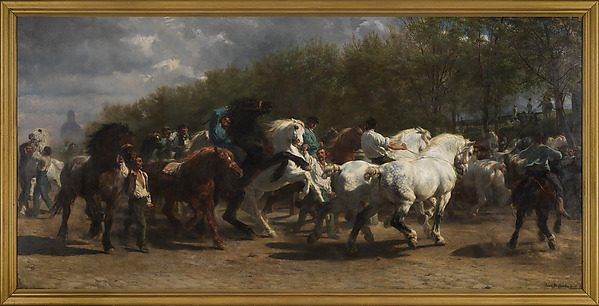
The counter-case, and it should be sat with. Rosa Bonheur was among the most commercially successful painters of her century — this canvas was the sensation of the 1853 Salon, toured for profit, and was engraved for a mass market. A woman reached the top of a nineteenth-century art market. That happened, and any account claiming women were simply absent has to explain it. Spies-Gans's archival work makes the same point at scale: over a thousand women exhibited more than six thousand works in London and Paris between 1760 and 1830. The barrier was never that the work did not exist.
5The body in the frame
The question of women in art is not only who made the work. It is also who is in it, and who the work assumes is looking.
Berger’s formulation in Ways of Seeing is the compact version: “men act and women appear. Men look at women. Women watch themselves being looked at.” He draws from this a split inside the depicted subject — “The surveyor of woman in herself is male: the surveyed female” — so that a woman comes to hold “the surveyor and the surveyed within her as the two constituent yet always distinct elements of her identity”.[6] Mulvey, three years later, gave the apparatus a name: women coded with “to-be-looked-at-ness” against a viewer positioned as the bearer of the look, in a voyeuristic or a fetishistic mode.[7]
Nochlin’s 1971 essay had already located the cause outside the individual and inside the institution: the answer to why there had been no great women artists was not talent but access — to training, to the life class, to the studio, to the succession.[8] Adams and colleagues explicitly position their own price study as the first empirical evidence for that argument.[1] The Guerrilla Girls’ count is the same claim reduced to two numbers: a body was far likelier to enter the museum as a subject than as an author.[25]
Berger is blunt about the mechanism of the mirror, which is the trope the second plate below turns on: “You painted a naked woman because you enjoyed looking at her, you put a mirror in her hand and you called the painting Vanity, thus morally condemning the woman whose nakedness you had depicted for your own pleasure. The real function of the mirror was otherwise. It was to make the woman connive in treating herself as, first and foremost, a sight.”[6]
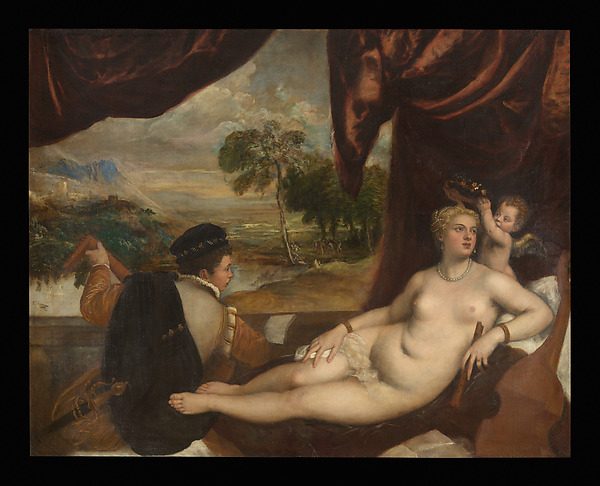
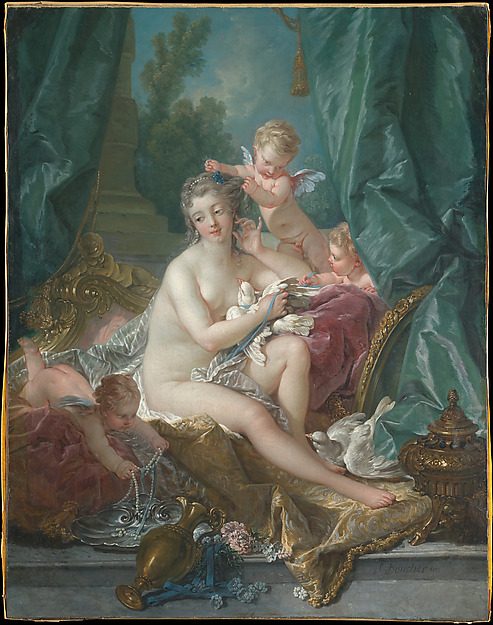
Two canonical pictures, chosen because the structure Berger describes is visible in the composition rather than argued into it. Left: the man is clothed, occupied, and turned to look; the woman is unclothed, still, and looked at. He acts, she appears. Right: the toilette, where the subject is arranged in the act of attending to how she will be seen. Neither painter's name is doing the work here — the arrangement is. That is the section's point: this apparatus is built into how the picture addresses whoever stands in front of it, and removing the maker's name from the label does not disturb it at all.
Two honest observations follow, and one admission.
First, this is a claim about a position, not about a person. The gaze Berger and Mulvey describe is built into how a picture addresses its viewer, and it operates whether or not the maker’s name is known. Anonymity does not disarm it. A gallery that removes names has removed nothing from the composition.
Second, what anonymity does reach is the other half — the part where the maker’s own body becomes part of the reading. When the artist is unnamed, no one can file the work under the artist’s gender, sexuality, or beauty; no profile can be written about the woman who painted it rather than about the painting. That is a narrow effect, and it is real. It is also the same effect Adams and colleagues measured from the other direction, since their respondents could not identify an artist’s gender from the work but assumed “male” 62.7% of the time — an assumption that, absent a name, has nothing to attach to.
The admission: we could find no rigorous econometric estimate of whether erotic content, or the gender of a depicted subject, affects auction price. This is a conspicuous hole in the cultural-economics literature — a market that prices almost everything has apparently not priced this — and we would rather report the hole than fill it with an anecdote.
6Attention, influence, and what a crowd does to a judgement
Simon’s formulation is the premise: a wealth of information creates a poverty of attention.[39]
The cleanest experiment on social influence in taste remains Salganik, Dodds and Watts’s artificial music market: 14,341 participants, 48 unknown songs, one independent world and eight social-influence worlds evolving in parallel, each showing only its own download counts. In both experiments, all eight influence worlds produced greater inequality of market share than the independent world, and success became less predictable as the social signal grew more salient.[37]
It is important to state what this does not show. The authors are explicit that quality remained positively related to success: songs of any given quality experienced a wide range of outcomes, but the best never did very badly and the worst never did extremely well. The follow-up, which inverted the displayed rankings, found that most songs experienced self-fulfilling prophecies — and that the inversion was not self-fulfilling market-wide, because the best songs recovered.[38] Social influence widens the distribution and randomises rank. It does not replace judgement.
Crypto art markets, where every transaction is public, let the same question be asked with complete data. Nadini and colleagues analysed 6.1 million trades of 4.7 million NFTs. The top 10% of traders perform 85% of all transactions and touch 97% of all assets; the average sale price is under $15 for 75% of assets; only about 20% of assets ever have a secondary sale.[30] Then the finding that matters here:
What predicts a price, and what doesn't
Adjusted R² for predicting an NFT's secondary sale price. The median sale price of the collection it belongs to — that is, its neighbours' prices — alone explains more than half the variance, reaching 0.90 one week ahead. What the object looks like, encoded as visual features from a convolutional network, explains between nothing and 0.08. The position of its traders in the trading network explains between 0.05 and 0.12. This is the single most direct measurement in the literature of how little the appearance of a work contributes to its price.
Source: Nadini, Alessandretti, Di Giacinto, Martino, Aiello & Baronchelli (2021), Scientific Reports 11, 20902.
Table view
| Predictor | Adjusted R² |
|---|---|
| Collection median price (1 week ahead) | 0.90 |
| Collection median price (2 years ahead) | 0.77 |
| Trader-network centrality, alone | 0.05 – 0.12 |
| Visual features, alone | 0.00 – 0.08 |
| Centrality + visual features | 0.18 – 0.25 |
Some of that price signal is not a signal at all. Chainalysis identified 262 users who sold an NFT to a self-financed address more than 25 times; 110 were profitable, earning $8,875,315 between them.[19] von Wachter and colleagues, across the 52 largest collections, found 3.93% of addresses and 2.04% of sale transactions triggering suspicions of market abuse.[46] A market that prices neighbours rather than objects can be moved by trading with yourself.
7Blind evaluation: what removing a name actually does
The best-known evidence for blinding is weaker than its reputation, and the story of how that happened is itself a demonstration of this paper’s thesis.
Goldin and Rouse studied the adoption of screens at symphony orchestra auditions.[24] The 1997 working paper’s abstract states that the screen “increases by 50% the probability a woman will be advanced out of certain preliminary rounds” and enhances “by severalfold” her likelihood of winning a final. Those are the numbers that entered general circulation.
The abstract of the paper as published in the American Economic Review three years later reads differently:
“Although some of our estimates have large standard errors and there is one persistent effect in the opposite direction, the weight of the evidence suggests that the blind audition procedure fostered impartiality in hiring and increased the proportion women in symphony orchestras.”
The caveat did not propagate. Aggregators still serve the working-paper abstract against the published article’s DOI. A 2019 public re-reading by Pallesen argues the underlying tables are thinner than the headline suggests — parts of the roster analysis rest on one to three orchestras — though that re-reading is not peer reviewed and its readings of the tables have not, so far as we can establish, been independently checked against the tables themselves.[32] We take no position on who is right. We note only that the confident version is not the published version, and that a paper about how names carry unearned weight was itself transmitted by reputation rather than by reading.
The strongest evidence for blinding comes from elsewhere. Tomkins, Zhang and Heavlin randomly assigned 1,498 submissions to the WSDM 2017 conference to single-blind or double-blind review — a genuine randomised controlled trial of knowing who wrote something.[42]
What knowing the author is worth
Log-odds of acceptance under single-blind versus double-blind review, with 95% confidence intervals, from a randomised trial on 1,498 conference submissions. Seeing the authors' identities roughly doubled the odds for papers from companies (×2.10), and raised them by about 60% for famous authors (×1.63) and top-50 universities (×1.58). The effect for female authors was negative but not distinguishable from zero in this data (p = 0.160) — it reached significance only in meta-analysis with six other studies. Single-blind reviewers also bid on 22% fewer papers: knowing who wrote something changes what you are willing to look at.
Source: Tomkins, Zhang & Heavlin (2017), PNAS 114(48), Tables 5 and 6.
Table view
| Identity cue | Coefficient | 95% CI | Odds multiplier | p |
|---|---|---|---|---|
| Company affiliation | +0.74 | 0.27 to 1.21 | ×2.10 | 0.002 |
| Famous author | +0.49 | 0.05 to 0.93 | ×1.63 | 0.027 |
| Top-50 university | +0.46 | 0.09 to 0.83 | ×1.58 | 0.012 |
| Female authors | −0.25 | −0.60 to 0.10 | ×0.78 | 0.160 |
Blank’s earlier experiment at the American Economic Review found acceptance rates lower and referees more critical under double-blind review.[13] Budden and colleagues reported a rise in female first-authored papers after Behavioral Ecology adopted double-blind review[17]; three separate rebuttals followed in the same journal within the year, and the question has not been cleanly resolved.[47]
The honest summary: blinding demonstrably changes outcomes, and the identity cues it most reliably removes are cues of institutional prestige — affiliation, fame, employer. That is a real and well-measured finding. The claim that blinding reliably corrects gender bias is supported by less evidence than is generally assumed, and the single most cited study for it is more cautious than its citations.
8Anonymity as practice, and what it costs
Anonymity in art is old, ordinary, and not free.
The Brontës published as Bell not to appear male but to avoid the question: “Averse to personal publicity, we veiled our own names under those of Currer, Ellis, and Acton Bell.”[16] The prejudice they were hedging against is documented in Southey’s reply to Charlotte: “Literature cannot be the business of a woman’s life.”[40] Mary Ann Evans became George Eliot in part to escape the category she had herself attacked. Elena Ferrante declared her absence in a 1991 letter to her publisher, before her first book appeared, and has sold more than 16 million copies in 48 countries; a 2016 unmasking rested on financial and property records rather than on anything in the writing. The Guerrilla Girls have worn gorilla masks and used dead women artists’ names since 1985. In crypto, the founding gesture of the medium is a pseudonym, and an English court has held that at least one claimant to it forged documents on a grand scale.[48]
Against this, the evidence that anonymity has a price is direct. Friedman and Resnick modelled communities where identities are cheap to discard and proved the cost formally: with persistent identities the social value is 1, with cheap pseudonyms it falls to 1 − 2α, where α is the share of newcomers. Their remedies are entry fees or free-but-unreplaceable pseudonyms; they explicitly reject removing anonymity.[23] Resnick and colleagues then measured it: in a randomised field experiment on eBay, the same dealer selling the same postcards earned an 8.1% price premium under an established identity versus new ones.[35]
Eight per cent is roughly what a reputation is worth when nothing else differs. An anonymous artist is choosing to leave it on the table, and should be told so plainly rather than sold anonymity as costless.
The Banksy case is instructive precisely because it is usually cited badly. Girl with Balloon partially shredded itself at Sotheby’s on 5 October 2018, selling for £1,042,000 with premium; as Love Is in the Bin it resold on 14 October 2021 for £18,582,000 — about 17.8×. But Banksy’s auction market inflated enormously over the same interval, so the multiple cannot be attributed to the shredding, the anonymity, or the event. It is a real number that supports much less than it is asked to.
9Equanimity
What follows is this gallery’s position. It is an argument, not a finding, and we mark the difference.
The evidence above supports a narrow claim and refuses a broad one.
The narrow claim: identity cues measurably change judgement, and the cues that move most reliably are cues of accumulated institutional standing — affiliation, fame, prior price, position in a network. This is established by randomised trial[42], by network data at scale[22], and by the direct observation that a work’s neighbours predict its price roughly ten times better than its appearance does.[30] Removing the name removes those cues. What is left is the work, and the judgement of whoever chose to show it.
The broad claim we decline: that anonymity produces fairness. It does not. Blinding redistributes attention rather than perfecting it; the crowd effects Salganik measured operate on anonymous works as readily as on named ones — the songs in that experiment had no reputations at all, and inequality still rose in all eight worlds. An anonymous market can concentrate exactly as a named one does, because concentration comes from cascade and attention, not from biography.
There is a further limit specific to this gallery. Radermecker’s finding — that provisional-name masters become brands, and that anonymous work prices on the specificity of its designation — implies that a wallet showing consistently will accrue reputation the way a name does. That is not a failure of the design. It is the design working: what is removed is not reputation but the shortcut to it. The biography, the face, the follower count, the school, the gender, the collector who already owns three. Those go. What has to be built instead is a body of work.
And the cost is real and should be stated: roughly 8% of price, on the only clean measurement anyone has.[35] Plus the harder, unmeasured costs — no critic can write the profile, no collector can build the relationship, no institution can give the retrospective. An artist who wants those things should not show here.
Which leaves the claim this gallery actually makes, and it is smaller than the one it tends to be read as making. Not that anonymity is fairer. Not that it corrects bias, or finds what the market missed, or tests anything about recognition — §10 rules all of that out, and a selected roster could not demonstrate it anyway. Only this: good work sells without a name attached.
That is a claim about whether the thing is liveable rather than whether it is just, and unlike the others it can be settled. Not by this survey — by a roster, a season, and a public record of what sold. The chain keeps that record whether it flatters us or not.
The wager is that some work is better served by being looked at than by being introduced. It remains a wager, and the literature does not settle it. The gallery’s own books will.
10The case against this gallery
The strongest objection is not to anonymity in general. It is to this gallery in particular, and it has four parts.
One: anonymity that only the public experiences is not anonymity, it is an information asymmetry. If a director recruits an artist who is already known — established, or visibly rising — the reputation does not disappear when the label comes off. It relocates. Anyone who recognises the hand, or who was told in a direct message, now holds private information that the anonymous label conceals from everyone else. That is strictly worse than a named market, in which the reputation at least trades in the open. It is the Knoedler structure inverted: there, buyers overpaid because they could not verify a name that was false; here, insiders could underpay because they can verify a name that is hidden.
Two: the artist holds a reveal option, and the gallery holds the cost. Anonymity here is revocable, and revocable by exactly the party who gains from timing it. An established artist can show unnamed, absorb no reputational risk, and disclose later — or selectively, to collectors — at which point the work re-rates. The gallery has meanwhile paid the full price of anonymity: no press, no profile, no critic able to write the piece that makes a career. If a work is later revealed to be by a known artist, the collector who guessed correctly is rewarded for having had access, not for having looked. That is the precise opposite of “let the work earn its reverence”.
Three: the model is regressive. The measurable cost of showing without a name — 8.1% on the only clean experiment[35] — is the floor, and it is paid most heavily by whoever has least. An established artist forgoes an increment on a reputation already banked. An emerging artist forgoes the thing that compounds: the public track record that produces the next show, the write-up, the representation. Fraiberger and colleagues show that an artist’s network position locks in early and then predicts everything after it[22] — which means the years in which a public record matters most are exactly the years this gallery asks an artist to forgo one. Anonymity is cheapest for those who already have names and dearest for those who do not, which inverts the stated purpose.
Four: the reputation does not vanish, it moves up one level. This is the objection with the paper’s own evidence behind it. Nadini and colleagues find that what predicts a digital work’s price is the median price of the collection it belongs to — adjusted R² 0.90 — while what the work looks like predicts between nothing and 0.08.[30] Radermecker finds that provisional names become brands in their own right.[33] Put together: an anonymous gallery does not abolish the name. It substitutes one name — the gallery’s — for many. The anti-name argument turns out to be a pro-one-name argument, and the entity that accumulates is the institution rather than the artist. A gallery that describes itself as the work has, at minimum, no grounds to be surprised by this.
And the crossover cuts the same way. Digital art has spent the last five years acquiring the blue-chip apparatus rather than escaping it — auction departments, museum acquisitions, gallery representation, certificates, authentication, provenance. The Beeple sale entered the peer-reviewed record as the third-highest price achieved for a living artist.[30] The direction of travel is toward legibility, not away from it. This gallery is rowing the other way, and the current it is rowing against is where the money is.
There is one further objection, and it is the sharpest, because it is the paper’s own §4 turned around. If directors select artists they already know to be good, the gallery is not testing whether anonymity lets unrecognised quality surface. It has pre-selected on reputation and then concealed it. Cameron, Goetzmann and Nozari made exactly this argument about the Yale sample — that an apparently clean result reflected who got into the sample.[18] A curated anonymous gallery is a selected sample by construction. It cannot claim, from its own results, that anonymity works.
How much of this survives depends on a fact about the roster, and it should be stated rather than assumed.
The objections above are written for their strongest case: a gallery quietly hanging blue-chip names. That is not what this one is. The artists here are recognised inside a small digital-art scene and no further — no superstars, no auction records, no departments at Christie’s. That fact does real work, and it cuts in both directions.
It weakens objections one and two considerably. A reveal option is worth roughly what the name is worth, and a name known to a few thousand people on one platform is not worth much as an option. The concealed reputation is local rather than global, and the people who would recognise the hand are largely the same people already inside the scene — which is an asymmetry between the scene and the world, not between insiders and their own peers. It weakens objection three too: a cost borne roughly equally by a roster of mid-career artists is not regressive, because there is no star tier for whom it is nearly free.
It does not touch objection four. Reputation moving up a level — from artist to gallery — happens regardless of how famous the artists were to begin with. If anything a modest roster makes it likelier, since the gallery is then the largest name in the room.
And it introduces the strongest argument the evidence offers in the gallery’s favour, which happens to depend on precisely this condition. Adler’s model says stars can emerge among people of exactly equal ability, because appreciation requires accumulated knowledge and it is cheaper to acquire that knowledge about whoever is already discussed.[2] That mechanism needs a population of comparably good practitioners to operate on — which is the exact description of a small scene full of good work and no superstars. Salganik’s worlds are the experimental version: with 48 unknown songs of broadly similar quality, inequality rose in all eight social-influence worlds and rank became less predictable as the signal strengthened.[37]
If a scene’s hierarchy is generated by cascade rather than by merit — and in a field of comparably good work, Adler says it will be — then removing names is not removing information. It is removing noise. That is the one place where this gallery’s design and the published evidence line up exactly.
The claim has to stay bounded, though. Salganik’s own result is that quality remained positively related to success: the best never did very badly and the worst never did extremely well.[37] Cascade adds variance to a signal; it does not replace it. So the honest version is not “names are noise” but “in a flat field, names carry more noise than they do information” — which is a narrower claim, and the only one this literature will bear.
What survives of the gallery’s position, honestly stated:
Only the narrow claim. Removing names removes the specific cues that the evidence shows move judgement most — institutional prestige, affiliation, prior price. It does not remove reputation, does not produce fairness, and does not test itself. The public naming of directors is the one structural answer to the asymmetry objection: if the hand is hidden, the eye must be accountable, or nobody is.
The reveal option was the part that was fixable rather than arguable, and the fix is a rule rather than a paragraph. As of this edition it is published in the gallery’s ethos and its terms: the gallery and its directors never confirm an identity, to anyone, at any time, before or after a sale, and whether or not the information is already circulating; the rule is identical for every artist, with no commercial exception; publicly claiming a work is how an artist leaves; and being identified by somebody else breaks nothing, because the silence was never conditional on the secret holding.
That closes the option — nobody now holds a disclosure they can time — and it should be judged as what it is. It binds the gallery, not the artist, and no gallery can bind what a person says about their own work. It also does nothing whatever about objection four. A rule against naming artists is, if anything, a rule that concentrates naming on the institution.
11Limitations
This survey establishes no causal claim of its own; it assembles others’. The price literature is built almost entirely on auction data, which is a minority of the market by value and is selected on resale — Korteweg and colleagues show how badly that selection bites.[27] Dealer prices, which are most of the primary market, are largely unobservable, and we have deliberately not repeated widely circulated claims about dealer pricing norms that we could not source.
The gender literature disagrees with itself in ways this survey has presented rather than adjudicated; readers should be suspicious of any single number, including ours. Blind-evaluation evidence comes overwhelmingly from music auditions, academic peer review and hiring — none of which is an art market, and all of which have a defined vacancy and a bounded jury, which an art market does not.
Finally, this gallery is not a disinterested party. It has an argument in this, and it would be surprised to find the evidence pointing the other way. That is a reason to check the sources rather than to trust the summary — which is, in the end, the entire subject of the paper.
—References
- [1]Adams, R. B., Kräussl, R., Navone, M. & Verwijmeren, P. (2021). Gendered Prices. The Review of Financial Studies 34(8), 3789–3839. ↗
- [2]Adler, M. (1985). Stardom and Talent. The American Economic Review 75(1), 208–212.
- [3]McAndrew, C. (2026). The Art Market 2026. An Art Basel & UBS Report. Art Basel and UBS. ↗
- [4]Ashenfelter, O. & Graddy, K. (2003). Auctions and the Price of Art. Journal of Economic Literature 41(3), 763–787. Circulated as NBER Working Paper 8997 (2002).
- [5]Barthes, R. (1967). The Death of the Author, trans. R. Howard. Aspen 5+6. French text: « La mort de l'auteur », Mantéia 5 (1968); collected in Image–Music–Text (1977).
- [6]Berger, J. (1972). Ways of Seeing, chapter 3. BBC / Penguin.
- [7]Mulvey, L. (1975). Visual Pleasure and Narrative Cinema. Screen 16(3), 6–18. Written 1973.
- [8]Nochlin, L. (1971). Why Have There Been No Great Women Artists? ARTnews, January 1971.
- [9]Beckert, J. & Rössel, J. (2013). The Price of Art: Uncertainty and Reputation in the Art Field. European Societies 15(2), 178–195. ↗
- [10]Becker, H. S. (1982). Art Worlds. University of California Press.
- [11]Beggs, A. & Graddy, K. (2009). Anchoring Effects: Evidence from Art Auctions. The American Economic Review 99(3), 1027–1039.
- [12]Bikhchandani, S., Hirshleifer, D. & Welch, I. (1992). A Theory of Fads, Fashion, Custom, and Cultural Change as Informational Cascades. Journal of Political Economy 100(5), 992–1026.
- [13]Blank, R. M. (1991). The Effects of Double-Blind versus Single-Blind Reviewing: Experimental Evidence from The American Economic Review. The American Economic Review 81(5), 1041–1067.
- [14]Bocart, F., Gertsberg, M. & Pownall, R. A. J. (2022). An empirical analysis of price differences for male and female artists in the global art market. Journal of Cultural Economics 46(3), 543–565. Circulated as “Glass ceilings in the art market”, SSRN 3079017. ↗
- [15]Bourdieu, P. (1983). The field of cultural production, or: The economic world reversed. Poetics 12(4–5), 311–356.
- [16]Brontë, C. (1850). Biographical Notice of Ellis and Acton Bell. Prefixed to the 1850 edition of Wuthering Heights and Agnes Grey.
- [17]Budden, A. E., Tregenza, T., Aarssen, L. W., Koricheva, J., Leimu, R. & Lortie, C. J. (2008). Double-blind review favours increased representation of female authors. Trends in Ecology & Evolution 23(1), 4–6.
- [18]Cameron, L., Goetzmann, W. N. & Nozari, M. (2019). Art and gender: market bias or selection bias? Journal of Cultural Economics 43(2), 279–307.
- [19]Chainalysis (2022). The 2022 Crypto Crime Report, NFT chapter.
- [20]De Silva, D. G., Kosmopoulou, G., Pownall, R. A. J. & Press, R. (2022). Posthumous trading patterns affecting artwork prices. Applied Economics. Sample: all art auctions in London, 1741–1913.
- [21]Foucault, M. (1969). Qu'est-ce qu'un auteur ? Lecture to the Société française de philosophie, 22 February 1969. Bulletin de la Société française de philosophie 63(3), 73–104.
- [22]Fraiberger, S. P., Sinatra, R., Resch, M., Riedl, C. & Barabási, A.-L. (2018). Quantifying reputation and success in art. Science 362(6416), 825–829.
- [23]Friedman, E. J. & Resnick, P. (2001). The Social Cost of Cheap Pseudonyms. Journal of Economics & Management Strategy 10(2), 173–199. Working paper: Rutgers WP 1998-20.
- [24]Goldin, C. & Rouse, C. (2000). Orchestrating Impartiality: The Impact of “Blind” Auditions on Female Musicians. The American Economic Review 90(4), 715–741. Working paper: NBER 5903 (1997).
- [25]Guerrilla Girls (1989). Do women have to be naked to get into the Met. Museum? Screenprint on paper. Victoria & Albert Museum; Tate.
- [26]Halperin, J. & Burns, C. (2022). The Burns Halperin Report. Artnet News, 13 December 2022.
- [27]Korteweg, A., Kräussl, R. & Verwijmeren, P. (2016). Does it Pay to Invest in Art? A Selection-Corrected Returns Perspective. The Review of Financial Studies 29(4), 1007–1038.
- [28]Mei, J. & Moses, M. (2002). Art as an Investment and the Underperformance of Masterpieces. The American Economic Review 92(5), 1656–1668.
- [29]Morris, J. (2025). Handle with care: the problem with auction guarantees. Apollo Magazine, 7 October 2025. Figures attributed to Lindsay Dewar, ArtTactic.
- [30]Nadini, M., Alessandretti, L., Di Giacinto, F., Martino, M., Aiello, L. M. & Baronchelli, A. (2021). Mapping the NFT revolution: market trends, trade networks, and visual features. Scientific Reports 11, 20902.
- [31]Newman, G. E. & Bloom, P. (2012). Art and Authenticity: The Importance of Originals in Judgments of Value. Journal of Experimental Psychology: General 141(3), 558–569.
- [32]Pallesen, J. (2019). Blind auditions and gender discrimination. jsmp.dk, May 2019. A public re-reading of the Goldin & Rouse tables; not peer reviewed.
- [33]Radermecker, A.-S. V. E. (2019). Artworks without names: an insight into the market for anonymous paintings. Journal of Cultural Economics 43, 443–483.
- [34]Renneboog, L. & Spaenjers, C. (2013). Buying Beauty: On Prices and Returns in the Art Market. Management Science 59(1), 36–53.
- [35]Resnick, P., Zeckhauser, R., Swanson, J. & Lockwood, K. (2006). The value of reputation on eBay: A controlled experiment. Experimental Economics 9(2), 79–101.
- [36]Rosen, S. (1981). The Economics of Superstars. The American Economic Review 71(5), 845–858.
- [37]Salganik, M. J., Dodds, P. S. & Watts, D. J. (2006). Experimental Study of Inequality and Unpredictability in an Artificial Cultural Market. Science 311(5762), 854–856.
- [38]Salganik, M. J. & Watts, D. J. (2008). Leading the Herd Astray: An Experimental Study of Self-fulfilling Prophecies in an Artificial Cultural Market. Social Psychology Quarterly 71(4), 338–355.
- [39]Simon, H. A. (1971). Designing Organizations for an Information-Rich World. In M. Greenberger (ed.), Computers, Communications, and the Public Interest, 37–72. Johns Hopkins Press.
- [40]Southey, R. (1837). Letter to Charlotte Brontë, 12 March 1837.
- [41]Spies-Gans, P. (2022). A Revolution on Canvas: The Rise of Women Artists in Britain and France, 1760–1830. Paul Mellon Centre / Yale University Press.
- [42]Tomkins, A., Zhang, M. & Heavlin, W. D. (2017). Reviewer bias in single- versus double-blind peer review. Proceedings of the National Academy of Sciences 114(48), 12708–12713. Preprint arXiv:1702.00502.
- [43]Topaz, C. M., Klingenberg, B., Turek, D., Heggeseth, B., Harris, P. E., Blackwood, J. C., Chavoya, C. O., Nelson, S. & Murphy, K. M. (2019). Diversity of artists in major U.S. museums. PLOS ONE 14(3), e0212852.
- [44]Ursprung, H. W. & Wiermann, C. (2011). Reputation, price and death: an empirical analysis of art price formation. Economic Inquiry 49(3), 697–715.
- [45]Velthuis, O. (2005). Talking Prices: Symbolic Meanings of Prices on the Market for Contemporary Art. Princeton University Press.
- [46]von Wachter, V., Jensen, J. R., Regner, F. & Ross, O. (2022). NFT Wash Trading: Quantifying suspicious behaviour in NFT markets. arXiv:2202.03866.
- [47]Webb, T. J., O'Hara, B. & Freckleton, R. P. (2008). Does double-blind review benefit female authors? Trends in Ecology & Evolution 23(7), 351–353, with author reply 353–354. See also Whittaker (2008), TREE 23, 478–479, and Engqvist & Frommen (2008).
- [48]COPA v. Wright [2024] EWHC 1198 (Ch). Judgment of Mr Justice Mellor, 20 May 2024.
Written for this gallery’s ethos. Corrections are welcome and will be made in place; a survey that cannot be corrected is a pamphlet.